



Appointments
Request Appointment/Request Exam - After completing the respective forms, these requests will be processed by our services, and you will receive confirmation by email. The indications about the Agreements (Insurance/Subsystem) are merely informative, please request confirmation in the "Observations" field.
Schedule Appointment/Exam myHPA - By accessing myHPA Saúde you can make the appointment in real time, directly on the Doctor's schedule according to his availability.
You can also contact us at +351 282 420 400 Algarve | +351 269 630 370 Alentejo | +351 291 003 300 Madeira
Phone booking/service hours:
Monday to Friday: 8:00 AM to 7:00 PM, Saturday: 8:00 AM to 5:00 PM Sunday and Holidays: Closed
(National landline)
Your request has been successfully received. We will confirm your appointment shortly.
Download myHPA Saúde:


Stomatherapy Nursing Consultation (Ostomies)
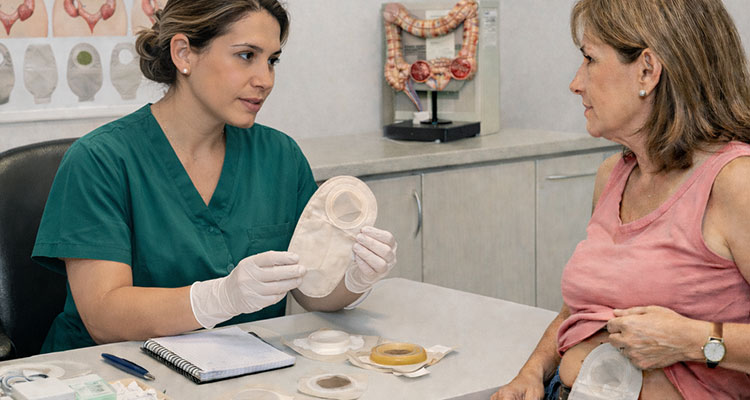
An ostomy is a surgical procedure that creates an opening (stoma) in the abdominal wall to divert the flow of faeces or urine into an external pouch. This may be required due to various conditions, such as cancer, trauma, or congenital malformations, and can be either temporary or permanent.
The creation of an ostomy whether intestinal or urinary represents a significant change in a person’s life. To ensure a safe, confident adaptation with the best possible quality of life, the CUF | Grupo HPA Saúde offers a Specialised Nursing Consultation for Ostomies, designed to provide technical, educational, and emotional support to people living with a stoma and their carers.
SERVICE AVAILABLE
AT OUR LOCATIONS*
Algarve
CUF Alvor Hospital
CUF Faro Hospital
Alentejo
Madeira
CUF Madeira Hospital
CUF Funchal Clinic
* Subject to change. Please confirm availability in advance by calling 282 420 400.
Purpose of the consultation:
This consultation is intended for all individuals who have undergone surgery involving the creation of a stoma, as well as those preparing for such a procedure. It also extends to the support of family members and caregivers, with the aim of fostering a safe and collaborative environment at home. Care is provided throughout every stage of the journey from surgical preparation (pre-operative), through hospitalisation, to discharge and reintegration into daily, personal, and professional life.
The consultation is carried out by nurses with specific training in stomatherapy, a nursing specialty focused on the care of patients with stomas. These professionals possess the technical expertise, experience, and communication skills necessary to deliver compassionate, precise, and person-centred care tailored to each patient’s unique needs.
During the Ostomy Nursing Consultation, patients receive personalised guidance on stoma and peristomal skin care, prevention and treatment of complications (such as skin irritation, leakage, retraction or prolapse), selection and fitting of appropriate devices, as well as practical training in self-care techniques. More than simply teaching procedures, this consultation aims to promote autonomy, safety, and acceptance of body image changes, contributing to emotional recovery and normalisation of daily life.
Our approach is individualised, respecting each person’s pace of adaptation. Nurses also provide support for a return to active life, addressing practical matters related to nutrition, clothing, physical activity, social relationships, and sexuality essential aspects of living well with an ostomy. We believe that with the right support, individuals are more capable of overcoming challenges and maintaining a high quality of life, even in the presence of significant anatomical changes.
What is an Ostomy?
An ostomy or stoma is a surgically created opening between a hollow organ and the exterior of the body, allowing the elimination of waste (faeces or urine) when the natural route is no longer viable. Elimination ostomies are generally classified as either intestinal or urinary, depending on their function.
Intestinal Ostomies
The main types of intestinal ostomies are colostomy and ileostomy, depending on the section of the bowel brought to the surface
Colostomy
An opening of the large intestine (colon) through the abdominal wall. Its location may vary—ascending, transverse, descending, or sigmoid colon and the consistency of the faeces depends on this location.
Ileostomy
An opening of the small intestine (ileum). Faeces are typically more liquid, more abundant, and contain higher enzymatic content, requiring particular attention to peristomal skin care.
Urinary Ostomies
Urinary ostomies encompass various surgical techniques, depending on the anatomical structures involved
Urostomy (or ureteroileostomy)
The ureters are connected to a segment of the intestine (usually the ileum), which is then brought to the abdominal surface, forming a functional stoma for urine elimination.
Ureterostomy
A direct opening between one or both ureters and the abdominal wall, without using an intestinal segment. This is less common and generally performed in specific cases.
Nephrostomy
A direct connection between the kidney and the exterior, using a catheter or drain to allow urine to exit the body. While not a traditional ostomy, it requires similar specialised care.
The need for an ostomy may arise from inflammatory bowel disease, cancer, trauma, congenital anomalies, or surgical complications. Continuous and personalised follow-up is essential to support patients throughout their recovery and long-term care.
The Ostomy Nursing Consultation reflects the commitment to clinical excellence and the humanisation of healthcare. This specialised service reinforces the role of nursing as a fundamental pillar in rehabilitation, therapeutic education, and emotional support for patients facing vulnerable and life-changing circumstances.
Request for Information
Enfermagem
You can consult your rights here.
You may revoke your consent at any time by sending an email to: dpo@grupohpa.com
You can read more about our Privacy Policy via this link.